The Essential Chomsky by Noam Chomsky
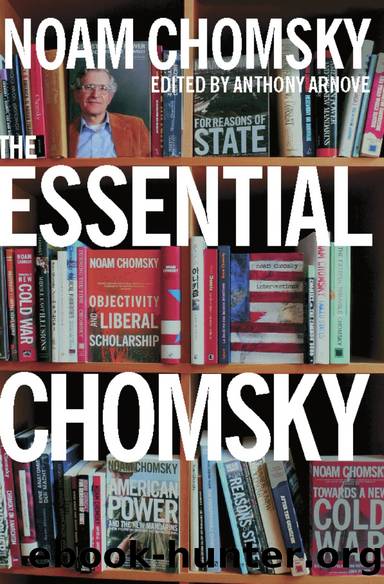
Author:Noam Chomsky
Language: eng
Format: epub
Publisher: The New Press
Published: 2018-11-15T00:00:00+00:00
This chapter first appeared in Necessary Illusions: Thought Control in Democratic Societies (Cambridge, MA: South End Press, 1989), 21â43.
17.
Introduction to The Minimalist Program
This work is motivated by two related questions: (1) what are the general conditions that the human language faculty should be expected to satisfy? and (2) to what extent is the language faculty determined by these conditions, without special structure that lies beyond them? The first question in turn has two aspects: what conditions are imposed on the language faculty by virtue of (A) its place within the array of cognitive systems of the mind/brain, and (B) general considerations of conceptual naturalness that have some independent plausibility, namely, simplicity, economy, symmetry, nonredundancy, and the like?
Question (B) is not precise, but not without content; attention to these matters can provide guidelines here, as in rational inquiry generally. Insofar as such considerations can be clarified and rendered plausible, we can ask whether a particular system satisfies them in one or another form. Question (A), in contrast, has an exact answer, though only parts of it can be surmised in the light of current understanding about language and related cognitive systems.
To the extent that the answer to question (2) is positive, language is something like a âperfect system,â meeting external constraints as well as can be done, in one of the reasonable ways. The Minimalist Program for linguistic theory seeks to explore these possibilities.
Any progress toward this goal will deepen a problem for the biological sciences that is already far from trivial: how can a system such as human language arise in the mind/brain, or for that matter, in the organic world, in which one seems not to find anything like the basic properties of human language? That problem has sometimes been posed as a crisis for the cognitive sciences. The concerns are appropriate, but their locus is misplaced; they are primarily a problem for biology and the brain sciences, which, as currently understood, do not provide any basis for what appear to be fairly well established conclusions about language.1 Much of the broader interest of the detailed and technical study of language lies right here, in my opinion.
The Minimalist Program shares several underlying factual assumptions with its predecessors back to the early 1950s, though these have taken somewhat different forms as inquiry has proceeded. One is that there is a component of the human mind/brain dedicated to languageâthe language facultyâinteracting with other systems. Though not obviously correct, this assumption seems reasonably well-established, and I will continue to take it for granted here, along with the further empirical thesis that the language faculty has at least two components: a cognitive system that stores information, and performance systems that access that information and use it in various ways. It is the cognitive system that primarily concerns us here.
Performance systems are presumably at least in part language-specific, hence components of the language faculty. But they are generally assumed not to be specific to particular languages: they do not vary in the manner of the cognitive system, as linguistic environments vary.
Download
This site does not store any files on its server. We only index and link to content provided by other sites. Please contact the content providers to delete copyright contents if any and email us, we'll remove relevant links or contents immediately.
| Anthropology | Archaeology |
| Philosophy | Politics & Government |
| Social Sciences | Sociology |
| Women's Studies |
The Secret History by Donna Tartt(19460)
The Social Justice Warrior Handbook by Lisa De Pasquale(12289)
Thirteen Reasons Why by Jay Asher(9110)
This Is How You Lose Her by Junot Diaz(7053)
Weapons of Math Destruction by Cathy O'Neil(6459)
Zero to One by Peter Thiel(5936)
Beartown by Fredrik Backman(5925)
The Myth of the Strong Leader by Archie Brown(5622)
The Fire Next Time by James Baldwin(5577)
How Democracies Die by Steven Levitsky & Daniel Ziblatt(5320)
Promise Me, Dad by Joe Biden(5227)
Stone's Rules by Roger Stone(5183)
A Higher Loyalty: Truth, Lies, and Leadership by James Comey(5080)
100 Deadly Skills by Clint Emerson(5022)
Rise and Kill First by Ronen Bergman(4889)
Secrecy World by Jake Bernstein(4863)
The David Icke Guide to the Global Conspiracy (and how to end it) by David Icke(4841)
The Doomsday Machine by Daniel Ellsberg(4611)
The Farm by Tom Rob Smith(4597)
